Cable Barriers
High-tension cable median barrier systems for divided highways — cost-effective cross-median crash prevention.
High-tension cable barriers are the most cost-effective solution for preventing cross-median crashes on divided highways — the type of collision that accounts for a disproportionate share of highway fatalities. Ideal Fencing Corp installs MASH-tested cable barrier systems across 13 states, where DOTs have invested heavily in cable barrier programs on interstate and state highway medians.
How Cable Barriers Work
Cable barrier systems use three or four high-strength steel cables tensioned between anchor terminals, supported by frangible steel or composite posts. When a vehicle impacts the system, the posts release (by design), and the tensioned cables absorb and distribute the impact energy over a longer length than rigid barriers. The vehicle is captured within the cable array and redirected along the barrier without crossing the median into opposing traffic.
The key advantage is deflection — cable barriers absorb energy through cable stretch and post failure, producing lower deceleration forces on vehicle occupants than rigid barriers. This deflection requires adequate median width (16 feet minimum for 4-cable systems, 24 feet for 3-cable), making cable barrier ideal for the wide medians found on rural interstates and divided highways throughout our service territory.
Systems and Manufacturers
We install cable barrier systems from the major approved manufacturers: Trinity Highway (CASS), Brifen Wire Rope Safety Fence, Gibraltar Cable Barrier, and Nucor Skyline Cable Barrier. Each system has been independently crash-tested to MASH TL-3 or TL-4 and appears on the approved products lists of the state DOTs in our territory. We select systems based on the state DOT specification, median width, and project-specific requirements.
Cable Barrier Programs Across Our Territory
Every state DOT in our service area maintains an active cable barrier program. Washington State DOT was an early adopter and has one of the nation's largest cable barrier inventories, with hundreds of miles on I-5, I-90, I-82, and state routes. Colorado, Oregon, Idaho, Montana, Utah, New Mexico, Kansas, Wyoming, Kentucky, Tennessee, Ohio, and Nebraska have followed with their own programs, prioritizing corridors with the highest cross-median crash histories.
Our installation and maintenance experience spans all thirteen states, giving us the specification knowledge and field experience to perform efficiently regardless of which state the project is in.
Installation and Maintenance
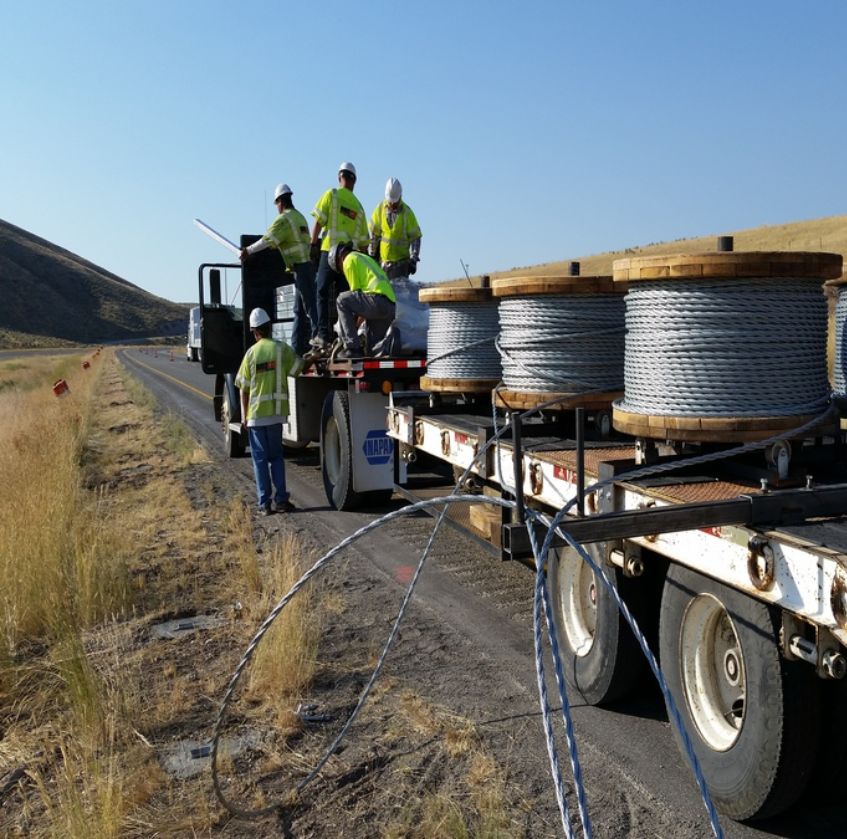
Our cable barrier crews install 2,000 to 4,000 feet per day using company-owned post driving and cable tensioning equipment. A 10-mile installation typically takes 15 to 25 working days. Post-installation, we verify cable tensions with calibrated tension meters and document every anchor, splice, and terminal for as-built records.
Cable barrier is a maintenance-intensive system by design — posts are meant to break on impact and require replacement, cables lose tension over seasonal temperature cycling, and impacts require splice repairs. We offer annual maintenance contracts that include quarterly tension checks, post replacement inventory management, impact damage repair within 48 hours, and annual condition reporting for asset management.
Cost Advantage
At $12 to $28 per linear foot installed, cable barrier costs 30 to 50 percent less than W-beam median barrier. This cost advantage allows DOTs to protect more miles of divided highway within fixed safety budgets — and the crash reduction data confirms the investment: 95 to 97 percent reduction in cross-median crashes on fenced corridors.
Ready to Start Your Project?
Get a free, no-obligation quote from our team of commercial fencing and guardrail experts.
Key Features
- Three-cable and four-cable high-tension systems
- MASH TL-3 and TL-4 crash tested
- Frangible posts designed for controlled release on impact
- 2,000 to 4,000 linear feet installed per day
- 60-75% cost savings over rigid barrier systems
- Annual maintenance contracts with 48-hour repair response
- Company-owned tensioning and post driving equipment
- Compatible with snowplow operations
Applications
Technical Specifications
| Cable Configuration | 3-cable or 4-cable systems |
| Cable Tension | 2,000 to 5,000 lbs per cable |
| Post Type | Frangible steel or composite |
| Post Spacing | 16 ft on center typical |
| Dynamic Deflection | 4 to 12 ft depending on system |
| Test Level | MASH TL-3 or TL-4 |
Frequently Asked Questions
Request a Free Quote
We'll review your project and respond within 2 business hours.