Box Beam Guardrail
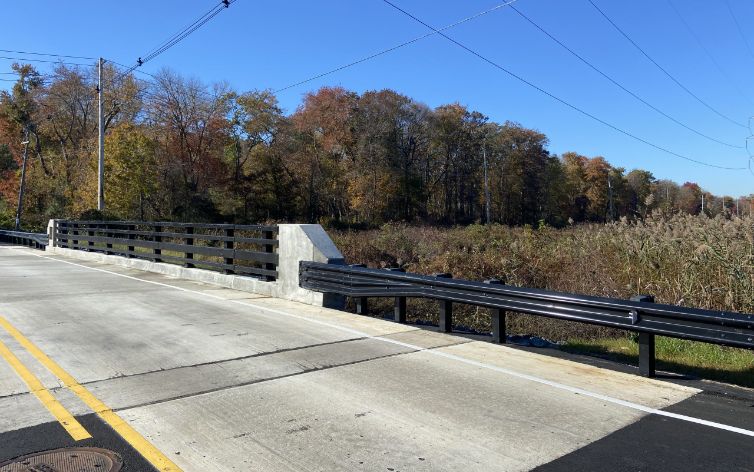
Heavy-duty box beam guardrail for bridge approaches, high-risk curves, and locations requiring increased structural capacity.
Some roadside hazards demand more containment than standard W-beam can provide. Box beam guardrail delivers the structural rigidity needed at bridge approach transitions, tight horizontal curves, high-fill embankments, and locations where deflection space behind the rail is limited. Ideal Fencing Corp installs box beam systems across Colorado, Washington, Oregon, Idaho, Montana, Utah, New Mexico, Kansas, Wyoming, Kentucky, Tennessee, Ohio, and Nebraska — the high-value guardrail work that requires precise engineering and experienced fabrication crews.
Box Beam Systems
Box beam guardrail uses a rectangular hollow structural section (HSS) rail element — typically 6-inch by 6-inch or 6-inch by 8-inch steel tube — mounted on steel posts with block-out spacers. The tubular profile provides significantly greater bending strength and rigidity than corrugated W-beam, allowing the system to redirect vehicles with less deflection. This makes box beam the preferred choice where there is limited clear zone behind the guardrail.
**Standard Box Beam**: 6x6 or 6x8 HSS rail on W6x15 posts at 6-foot 3-inch spacing. Used at bridge approach transitions, sharp curves, and high-fill locations where reduced deflection is critical.
**Nested Box Beam**: Double-rail configuration for TL-4 and TL-5 containment at bridge ends, toll plazas, and locations with heavy truck traffic. Provides enhanced structural capacity for high-energy impacts.
**Thrie-Beam to Box Beam Transitions**: We install the transition sections that connect W-beam or Thrie-beam highway runs to box beam bridge approach sections. These transitions must be installed to precise dimensional tolerances — improper transitions have been implicated in numerous guardrail penetration incidents.
Bridge Approach Applications
The majority of our box beam work involves bridge approach guardrail — the critical 200 to 500 feet on each side of a bridge structure where guardrail transitions from flexible highway systems to rigid bridge rail. This transition zone is one of the most engineered sections of any highway project. We install box beam approach rails, bridge rail transitions, and end terminals per state DOT bridge approach standard drawings, with independent verification measurements before, during, and after installation.
Where Box Beam Is Specified
State DOTs in our territory specify box beam guardrail at bridge approaches (most common application), sharp horizontal curves where deflection would push vehicles off embankments, high-fill sections where guardrail protects against severe drop-offs, tunnel approaches and portals, and gore areas at interchange ramps. Box beam costs more per foot than W-beam but is specified only where the engineering requires its higher performance.
Production and Quality
Box beam installation requires more precision than W-beam — rail splice joints must be aligned within tight tolerances, and post locations must match design stations precisely. Our crews install 400 to 800 feet of box beam per day, with quality checks at every splice and post. We own the specialized equipment for box beam post driving and rail setting, including crane trucks for handling the heavier rail sections.
Investment
Box beam guardrail ranges from $45 to $85 per linear foot depending on rail profile, post size, and state specifications. Bridge approach installations including transition hardware typically run $50,000 to $120,000 per bridge end. We provide detailed unit pricing per DOT bid item format.
Ready to Start Your Project?
Get a free, no-obligation quote from our team of commercial fencing and guardrail experts.
Key Features
- 6x6 and 6x8 HSS steel tube rail profiles
- Reduced deflection for limited clear-zone locations
- Nested double-rail for TL-4 and TL-5 containment
- Precision bridge approach transitions
- DOT-approved end terminal systems
- 400 to 800 linear feet installed per day
- Independent verification measurements at every splice
- Company-owned crane trucks and specialized equipment
Applications
Technical Specifications
| Rail Profile | 6x6 or 6x8 HSS rectangular tube |
| Rail Gauge | 10-gauge to 7-gauge depending on application |
| Post Type | W6x15 steel, 6 ft embedment typical |
| Post Spacing | 6 ft 3 in standard |
| Containment | TL-3 (standard), TL-4/TL-5 (nested) |
| Deflection | 2 to 4 ft (significantly less than W-beam) |
Related Services
W-Beam Guardrail
MASH and NCHRP 350 compliant W-beam guardrail for highways, interchanges, and roadside hazard protection.
Impact Attenuators
MASH-tested crash cushions, sand barrels, and water-filled attenuators for highway gore areas, bridge piers, and fixed hazards.
Bridge Rail
Concrete and steel bridge railing systems, retrofit upgrades, and bridge-to-guardrail transitions for DOT bridge projects.
Frequently Asked Questions
Request a Free Quote
We'll review your project and respond within 2 business hours.