W-Beam Guardrail
MASH and NCHRP 350 compliant W-beam guardrail for highways, interchanges, and roadside hazard protection.
When a DOT project manager specifies guardrail, the timeline for installation is not flexible — road users are exposed to unshielded hazards until the rail goes up. Ideal Fencing Corp installs W-beam guardrail systems across 13 states with the speed, documentation, and MASH compliance that state DOTs require. We are DOT-approved in Colorado, Washington, Oregon, Idaho, Montana, Utah, New Mexico, Kansas, Wyoming, Kentucky, Tennessee, Ohio, and Nebraska, and our crews install an average of 1,200 feet of W-beam per day under standard conditions.
W-Beam Guardrail Systems
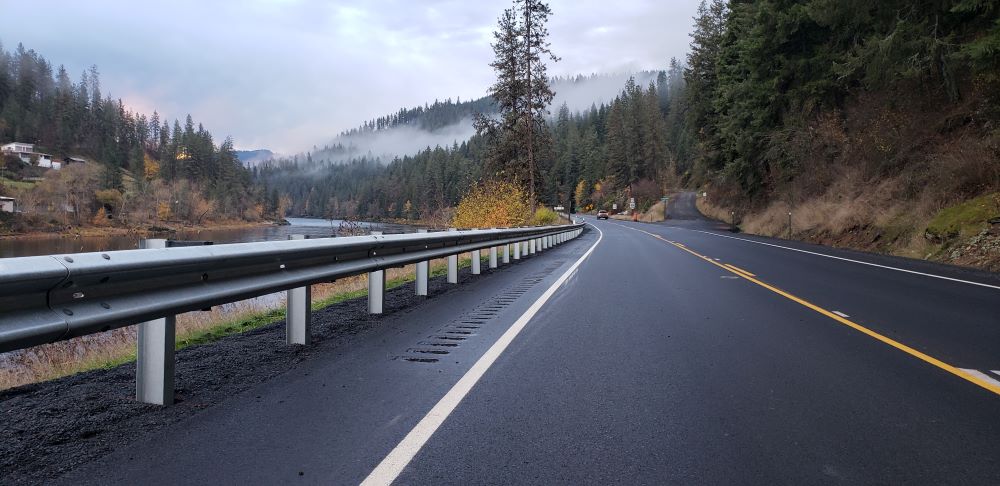
W-beam guardrail is the most widely deployed roadside barrier system in the United States. The corrugated steel rail profile — shaped like the letter W — absorbs impact energy by deflecting and deforming in a controlled manner, redirecting vehicles back toward the travel lane while decelerating the occupants at survivable rates. We install complete W-beam systems including rail, posts, blocks, end terminals, and transitions.
**Standard W-Beam**: 12-gauge galvanized steel rail on W6x8.5 or W6x15 steel posts at 6-foot 3-inch spacing. Block-outs (either steel or recycled plastic) maintain the rail offset from posts to prevent vehicle snagging. This is the standard system specified for the majority of state highway and interstate guardrail applications.
**Thrie-Beam**: A wider three-wave profile used at bridge approaches, transitions, and locations requiring increased rail height for truck traffic. Thrie-beam provides a higher mounting height and greater structural capacity than standard W-beam.
**MGS (Midwest Guardrail System)**: The current MASH TL-3 tested standard adopted by most Western state DOTs. MGS uses 31-inch mounting height, 37.5-inch post embedment, and steel or composite block-outs. Our crews install MGS per the AASHTO Roadside Design Guide and applicable state DOT standard drawings.
End Terminals and Transitions
End terminals are where the engineering matters most — an improperly installed terminal can spear a vehicle instead of attenuating the impact. We install MASH-tested terminals including the SKT-SP, FLEAT, SRT, and ET-Plus systems. Our foremen verify terminal installation dimensions with calibrated measurements and photo-document every terminal for as-built records. Guardrail-to-bridge rail transitions and median barrier connections are installed per the approved transition drawings for each state DOT.
DOT Specification Compliance
Every state DOT in our territory maintains unique guardrail specifications, standard drawings, and material approval lists. We maintain current specification libraries for CDOT, WSDOT, ODOT, ITD, MDT, UDOT, NMDOT, KDOT, WYDOT, KYTC, TDOT, ODOT (Ohio), and NDOT (Nebraska). Our project managers verify material certifications, galvanizing reports, and post steel heat numbers before materials arrive on site. We produce as-built documentation packages that include post driving logs, rail splice locations, terminal installation photos, and material certifications — everything a DOT inspector needs for project acceptance.
Regional Expertise — Adarand and RailCo
Our guardrail capability is strengthened by two operating divisions with deep local roots. Adarand Constructors, our Colorado Springs division, has been CDOT's trusted guardrail contractor for over 40 years — roughly 85% of their contracts come directly from CDOT and local Colorado governments. Their I-25 Castle Rock to Monument guardrail project and decades of statewide CDOT maintenance work demonstrate a track record few competitors can match. In the Northwest, RailCo LLC operates from Boise and brings specification-driven guardrail installation to Idaho, eastern Oregon, western Wyoming, and northern Utah. RailCo's Kevin Wade and Agustine Madrigal lead crews with combined 50+ years of guardrail expertise and AGC national recognition. Both divisions maintain material inventory — including new and used guardrail for sale — ensuring rapid mobilization and competitive pricing across the entire region.
Production Rates and Mobilization
Our guardrail crews install 800 to 1,500 feet of W-beam per day depending on terrain, post driving conditions, and traffic control requirements. We own our post drivers, rail setters, and support equipment — no rental equipment delays. With equipment yards in Colorado (Adarand), Idaho (RailCo), and our other regional offices, mobilization to project sites within our 13-state territory typically takes 5 to 10 business days from notice to proceed. For emergency guardrail repair (crash damage, storm damage), we maintain a 24 to 72 hour response capability.
Pricing
W-beam guardrail installation typically ranges from $22 to $45 per linear foot for standard highway applications. End terminals range from $2,500 to $6,500 per unit depending on type. Guardrail repair and replacement for crash-damaged sections is priced per occurrence. We also sell new and used guardrail material through Adarand Constructors for agencies and contractors who prefer to self-install. We provide detailed unit pricing that aligns with DOT bid item formats for straightforward comparison with engineer's estimates.
Ready to Start Your Project?
Get a free, no-obligation quote from our team of commercial fencing and guardrail experts.
Key Features
- MASH TL-3 tested Midwest Guardrail System (MGS)
- 12-gauge galvanized steel rail per AASHTO M-180
- Steel and composite block-out options
- MASH-tested end terminals: SKT-SP, FLEAT, SRT, ET-Plus
- Guardrail-to-bridge rail transitions
- 800 to 1,500 linear feet installed per day
- Company-owned post drivers and rail setting equipment
- 24-72 hour emergency repair response
Applications
Technical Specifications
| Rail Profile | W-beam (2-wave) and Thrie-beam (3-wave) |
| Rail Gauge | 12-gauge galvanized steel per AASHTO M-180 |
| Post Type | W6x8.5 or W6x15 steel, 6 ft embedment |
| Post Spacing | 6 ft 3 in standard (MGS) |
| Mounting Height | 31 inches (MGS standard) |
| Test Level | MASH TL-3 (NCHRP 350 TL-3 legacy systems) |
Related Services
Box Beam Guardrail
Heavy-duty box beam guardrail for bridge approaches, high-risk curves, and locations requiring increased structural capacity.
Impact Attenuators
MASH-tested crash cushions, sand barrels, and water-filled attenuators for highway gore areas, bridge piers, and fixed hazards.
Bridge Rail
Concrete and steel bridge railing systems, retrofit upgrades, and bridge-to-guardrail transitions for DOT bridge projects.
Frequently Asked Questions
Request a Free Quote
We'll review your project and respond within 2 business hours.